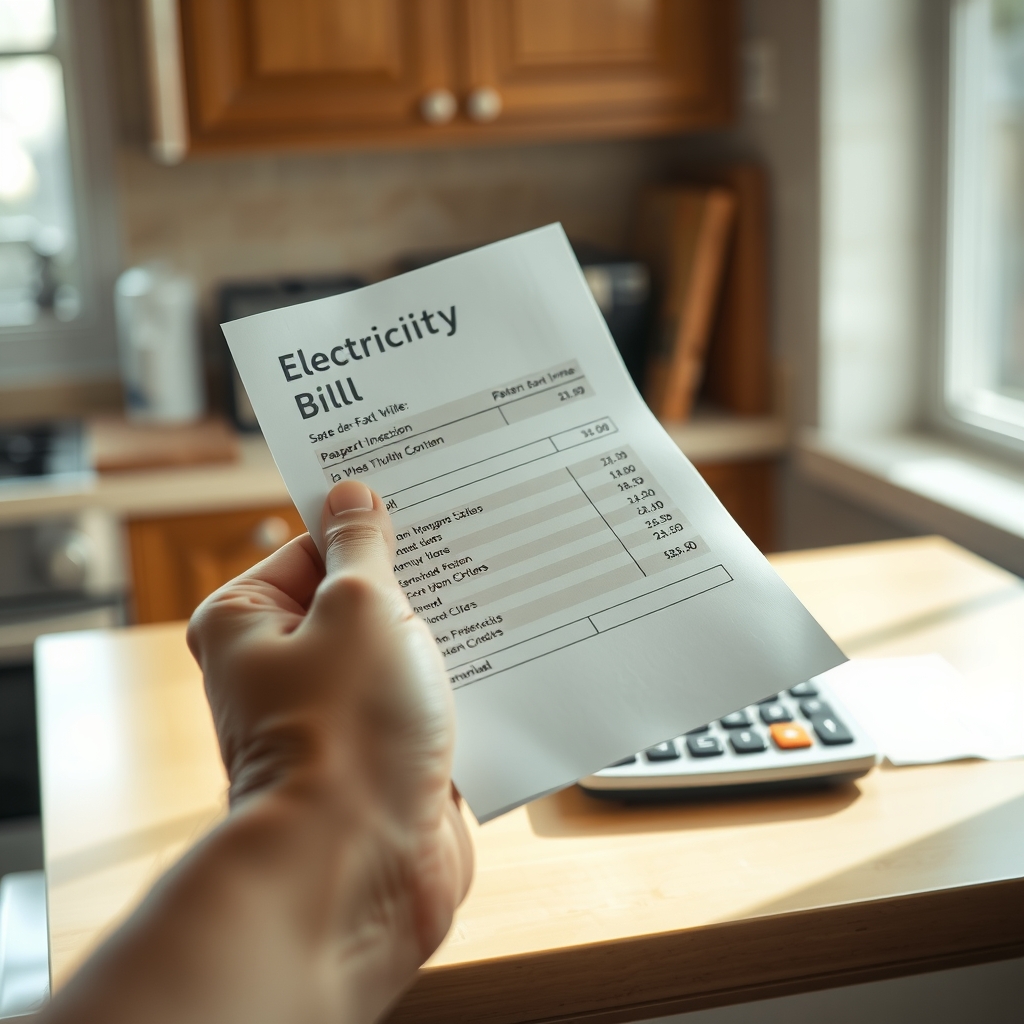
To work out what you actually pay for electricity, divide the total amount due by the kilowatt-hours on the bill. That single number, your effective rate in cents per kWh, is the only figure that lets you compare your bill to your neighbours' or to the rate you thought you signed up for.
Most bills bury this number. They show a supply rate, a delivery charge, a stack of riders and a total, and none of those lines is the price you paid per unit of electricity. The arithmetic takes ten seconds once you have the two numbers.
How do you calculate your cost per kWh?
- Find the total amount due for the billing period, including taxes and fees, not just the current charges subtotal.
- Find the kWh used for the same period.
- Divide the total by the kWh.
- Multiply by 100 to express it in cents.
A bill of $164.20 for 1,050 kWh works out to about 15.6 cents per kWh. If the same household uses 1,050 kWh with the same total, the rate did not change. What changes month to month is often the fixed portion spreading over fewer units, or a seasonal adjustment appearing.
Should you include taxes and fixed fees?
Yes, if the question is "what do I actually pay per unit". No, if the question is "is my supply rate correct against my contract". Those are two different audits, and mixing them produces a number that matches nothing.
For the first question, include everything. That is the figure a comparison against your area's typical residential rate should use, because the typical rate published by regulators is itself an all-in average.
Why does the bill show a supply rate that differs from your real cost?
Because the supply rate only covers the generation portion. Delivery, transmission, metering, and various program charges are added on top, and some of those are fixed monthly amounts rather than per-kWh rates.
Fixed charges are the reason a low-usage month looks expensive. If a bill carries a fixed monthly charge and you use very little electricity, the fixed amount dominates and your effective rate climbs even though nothing about your supply changed.
What is a demand charge?
A demand charge is billed on your highest short burst of consumption in the period, measured in kilowatts rather than kilowatt-hours, and it appears on some residential plans and many commercial ones. If a bill has a demand line, it can be a large share of the total while barely relating to the kWh you used.
How do you tell whether your rate is actually high?
Compare your effective cents per kWh against the typical residential rate for your utility's service area or your state. The comparison only makes sense when the two numbers are measured the same way: all-in against all-in, and for a comparable season.
Two practical cautions:
- Season matters. Summer and winter rates, and summer and winter usage, both move. Comparing a July bill to an annual average will mislead you in either direction.
- Usage tier matters. Many utilities charge a higher rate above a baseline allowance. A household using three times the baseline pays a higher average rate for the same plan.
| What you are comparing | Use | Do not use |
|---|---|---|
| Your bill vs area typical | Total due ÷ kWh | Supply rate alone |
| Contract vs actual | Supply rate per kWh | Total due |
| Month vs month | Same season, similar usage | Peak month vs spring |
How can you check a bill without doing the arithmetic?
You can do this by hand with a calculator, and it works. The friction is that the numbers change every month and the comparison rate is not printed on the bill.
WattWise handles the reading: you photograph or upload the bill, it extracts the utility, ZIP, kWh used, total due, billing days and supply rate, and you confirm or correct each figure before any maths runs. It then computes your effective rate and compares it against your area's typical residential rate, using the utility's own published residential tariff where available and otherwise the state residential average from the EIA Electric Power Monthly. Every result states its source and the date of the data, and cached or fallback data is labelled. The gauge, the verdict (overpaying, fair or good) and one line naming the likely culprit are free. The full audit is a one-time $14.99 and decodes every line, plus a printable PDF report. The bill photo is discarded after the numbers are extracted.
What usually explains an unusually high bill?
In rough order of how common they are:
- A hotter or colder month than usual, with heating or cooling running harder.
- A billing period that is longer than a month. Check the billing days: a 34-day period costs more than a 28-day one for identical habits.
- A rate change or an expired promotional rate on the supply side.
- Something running that should not be: a water heater, a pool pump, a second fridge, a space heater on a thermostat.
- An estimated rather than actual reading, later corrected on a subsequent bill.
Only the third item is a pricing problem. The rest are usage or billing mechanics, and they need different fixes.
Where can you find your area's typical rate?
Your utility's published tariff is the most precise source, and state regulators publish residential rate comparisons. For national averages by state, the US Energy Information Administration publishes the Electric Power Monthly. Those figures are averages across a whole state, so they are a benchmark rather than a verdict on your specific bill.
If your number sits well above the benchmark for your area in a normal month, the next step is to look at the supply line and the plan you are on rather than to assume the meter is wrong. Meters do fail, but rarely, and the utility will usually check one for free if you ask.
What should you do if the rate looks wrong?
Ask the utility for a line-by-line explanation of the bill, in writing if you can. Ask specifically whether the rate changed, whether a promotion ended, and whether the reading was estimated. If a retailer supplies your power, compare the rate on the bill against the rate in your contract.
Keep one habit that makes all of this take a minute: note the kWh, the total and the billing days each month in a single list. A short table of six months shows you a trend, and a trend is what turns "this bill feels high" into a specific question with a specific answer.
FAQ
Is cost per kWh the same as the rate on my contract?
No. The contract rate usually covers supply only. Your effective cost per kWh includes delivery, fixed charges and taxes, so it is normally higher.
Why did my cost per kWh rise when I used less electricity?
Fixed monthly charges are spread over fewer kWh, which raises the average. Seasonal rate changes can have the same effect.
Can I compare my rate to a neighbouring state?
Loosely, but do not read much into it. Rates vary by utility, by state regulation and by season, so compare within your own utility's service area for anything actionable.
Does WattWise tell me which plan to switch to?
The free gauge does not. The paid audit includes the cheaper plan or supplier to switch to based on current location-applicable data, plus a script for the call.
This article is general information about reading an electric bill, not professional or financial advice.